


The world’s longest optical express network that runs “like clockwork”
Extending the optical path of a submarine network link beyond the Cable Landing Station (CLS) to the nearest convenient PoP or Data Center is now a common approach.
But what happens when the 'next hop' is over 1,700 km from the CLS, on top of the 5,900 km of submarine path between Brazil and Portugal?
In this Case Study we hear how EllaLink has used the capabilities of the Nokia Submarine Network solution to close what we believe is the longest all-optical backhaul in the world — between Lisbon, Portugal and Madrid in Spain.
All optical protection can be a particular challenge when very long terrestrial links are appended but, in the words of EllaLink Chief Operations Officer, Diego Matas, 'The solution works so reliably that we call it The Clockwork Network.

One cable. Three continents. A scale challenge without precedent.
The EllaLink submarine cable system is the only cable directly interconnecting Europe, Latin America and Africa in a single system: 5,900 km of subsea cable with four fibre pairs, designed from the outset for coherent optical transmission and data centre-to-data centre connectivity.But what makes EllaLink's network genuinely singular is not only the transatlantic distance.
It is what happens after the cable comes ashore.While one end of the cable lands in Sines, Portugal, the critical data centre interconnection point is Madrid, extending the optical path by a further 1,738 km beyond the 5,900 km transoceanic section. The result is the longest optically expressed subsea-terrestrial backhaul in operation anywhere in the world today.
The challenge: high availability at extreme distances, without regeneration
Modern submarine cable architectures increasingly eliminate optical-electrical-optical (OEO) regeneration at the cable landing station, relying instead on optical express architectures that reduce cost, power consumption and latency. The trade-off is that this approach places significantly greater demands on optical layer protection, particularly when the express path extends well beyond the CLS.
For EllaLink, that path runs from Sines to Madrid: 1,738 km of terrestrial network in optical continuity with 5,900 km of submarine cable, with no electrical conversion in between. Ensuring rapid, deterministic protection switching across that combined distance, without reintroducing OEO regeneration, was the defining engineering challenge.
The solution: end-to-end all-optical protection
Working closely with Nokia, EllaLink designed and validated an all-optical protection architecture spanning both submarine and terrestrial domains. The solution integrates Nokia ICE6 coherent transponders with the Nokia 1830 FlexILS submarine line system, combined with Nokia Optical Protection Switch Modules (OPSMs) that enable fast optical protection switching without any transmission equipment at the CLS.The architecture works as follows: a 50:50 optical splitter sends identical signals over physically diverse paths; an OPSM combiner selects the active path at the receive end; and protection switching is triggered by loss of light, based on configurable attenuation thresholds. The entire process occurs in under 50 ms — compliant with ITU-T G.841 — and is handled entirely within the optical domain.
An additional layer of sophistication lies in how the solution handles spectrum sharing. Using FlexILS ROADMs and Nokia Intelligent Power Management, optical protection can be applied per spectrum passband, aligned with individual Digital Line Sections (DLS) — enabling per-DLS protection without complex stacked switching architectures.
While optically expressed terrestrial backhauls are increasingly common in modern submarine networks, EllaLink's implementation is in a category of its own in terms of scale, reach and operational complexity. The 1,738 km optical-express terrestrial backhaul between Sines, Lisbon and Madrid is the longest of its kind in operation today.
As Diego Matas, Chief Operations Officer at EllaLink, puts it: "The solution works so reliably that we call it The Clockwork Network."
You May Also Like

Mauritania and EllaLink: Bridging Continents, Empowering a Digital Future
On Monday, July 28, 2025, EllaLink and the Government of Mauritania celebrated a defining milestone:
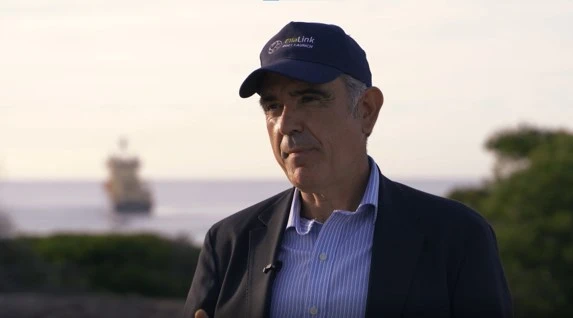
Throwback EllaLink Cable Landing Day, Sines
This is a throwback from EllaLink Cable Landing Day to share a testimonial of the importance of deve

EllaLink Shortlisted for Two Major Categories at the 2025 Global Connectivity Awards
We are proud to announce that EllaLink has been shortlisted for two categories at the highly estee